One of the more common calls a racking supplier receives sounds simple, in theory: “I need some beams.” A facility has damage, or wants to add a level, or is extending a row into open floor space. It seems like a parts order.
“It’s becoming more of a request nowadays,” says Chase Anderson, Technical Sales Representative at 3D Storage Solutions.
Whether it stays that simple depends on something some operators haven’t considered: the profile of the uprights already in the building.
What a racking profile is
The profile is the pattern punched into the upright column, the slots or holes that the beam connectors hook into. It sets which beam connectors will fit, and at what increments a beam can be positioned.
Different manufacturers from different eras have used different profiles. Some are still in production. Others have not been made in years. From the outside, two frames can look nearly identical. Up close, at the connection point, they may be quite different.
The profiles you are most likely to see in Canada
Redirack. This is the standard slotted profile in Canada and the one that gets manufactured most. The slots are square and set on 3-inch increments. If a facility has purchased new rack in Canada in recent years, this is very likely what it has.
Teardrop. This is the profile most common in the United States. The slot is shaped like an inverted teardrop, which is where the name comes from. Some Canadian facilities do have teardrop rack, often sourced from US catalogue suppliers. Some Canadian manufacturers will produce it and some do not.
Cubic. A legacy profile with a single slot in the centre of the column. It is no longer manufactured. Older buildings in Ontario still have it, sometimes at significant height.
Others. These three are not the whole list. There are other racking types such as Triple-A and MASTORAK, which are not as common as the above.
Why the profile matters before you add, repair, or retrofit
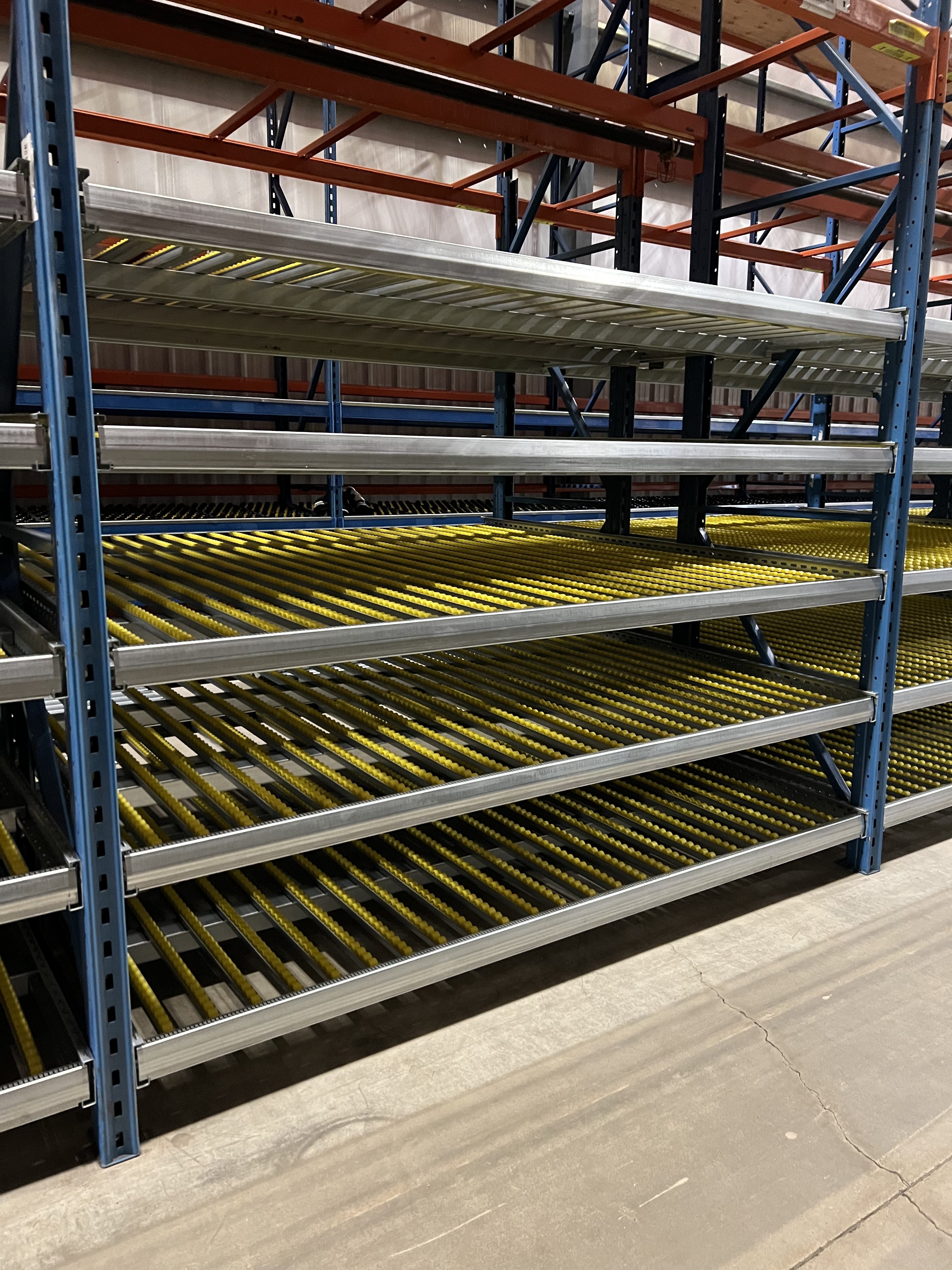
For Calendar Club, the cubic frames required different hardware, including longer bolts, and the system had to be designed from AutoCAD drawings of the existing rack so the tracks would fit precisely.
Beams for an obsolete profile cannot be ordered off the shelf. If the uprights are cubic or another discontinued profile, a standard beam will not connect. The only route to a replacement beam is custom fabrication: if the facility still has the original connector brackets, a standard beam can be welded onto those brackets. That is custom work with custom lead times. In the case of racking damage, sometimes a client will need to wait roughly six weeks for a single replacement beam to be made.
Retrofit components are designed around current profiles. Carton flow, for example, is designed to sit on a specific frame geometry, and the drawings suppliers typically assume a Radirack frame. One of 3D Storage’s Installations (Calendar Club), the cubic frames required different hardware, including longer bolts, and the system had to be designed from AutoCAD drawings of the existing rack so the tracks would fit precisely. The cubic profile also positioned beams on a 3/8-inch offset from the frame line, which is how that profile was built, and which a retrofit design has to account for.
Adding levels means adding beams, and the beams may not exist. A retrofit or expansion that looks like a small job can require far more beams than a facility has in surplus. For example, Calendar Club had spare beams, but not enough for a five-level carton flow build, which needs two beams per level. When the profile is obsolete, that shortfall cannot be closed with a purchase order.
The repair-versus-replace question has a compliance side. Replacing components with material of the exact same construction does not require engineering certification. A repair does. Repairs must follow strict guidelines and be approved by a structural engineer.
What to identify before assuming an add-on is simple
Before a quote can be accurate, a few things need to be known:
- The profile of the existing uprights. A clear photo of the slot pattern on the column, and of an existing beam connector, is usually enough to start.
- Whether any surplus beams or connector brackets are on site, and how many.
- What the change actually involves: replacing damaged beams, adding levels, extending a row, or retrofitting a system like carton flow into the existing frames.
With that in hand, the conversation can move to real options: whether matching material is still available, whether custom fabrication makes sense, whether the affected section is better replaced with current-profile rack, or whether the plan should change. Which option fits depends on the facility, the profile, and what the operation needs the rack to do.
Where 3D Storage Solutions fits
As an integrator, 3D is not tied to one manufacturer’s profile or catalogue. That matters most when the rack in the building is something nobody makes anymore. The first step is identifying what is actually there, then laying out what can be sourced, what has to be fabricated, and what the alternatives are.
“Let us look into your problem a little more,” says Anderson. “Odds are we have the connections, and if we don’t, we’ll be honest with you.”
If you are planning to add to, repair, or retrofit existing racking and are not sure what profile you have, a photo of the upright and a short conversation is a good place to start.
Related reading:
The Ontario Guide to Racking Inspections