In most warehouses, the picking operation grows quietly. SKU counts creep up. Order volume edges higher. Slotting gets rearranged a few times a year to accommodate seasonal shifts or new customers. At some point operations leaders start hearing the same complaints: pickers are walking too much, replenishment keeps getting in the way, and the occasional mispick is becoming… less occasional.
When that happens, the first instinct is often to look at labour. More pickers, longer shifts, tighter performance targets. Sometimes that is the right call. But in case-pick environments, the constraint is frequently the warehouse shelving layout itself. The system that worked when the operation was simpler is now the bottleneck.
Carton flow is one of the layout changes worth understanding before adding more people to the floor.
How static shelving performs in a case-pick environment
Static shelving is a workhorse for good reason. It is flexible, easy to reconfigure, and well-suited to:
- Operations with stable SKU profiles
- Lower to moderate pick velocity per face
- Item mixes with significant size or weight variation
- Picking zones where visibility and reconfigurability matter more than pick density
In those environments, static shelving holds up well and often remains the right answer.
The friction tends to show up elsewhere. As SKU counts grow, products often stay where they were originally placed, which is frequently on pallets. When the volume of those products no longer justifies a full pallet position, a familiar set of patterns starts to emerge:
Pick paths get longer. As SKUs spread across more pallet positions to keep up with growth, the distance between picks grows. Pickers spend more time walking and less time picking.
Slotting drifts out of alignment. Fast movers and slow movers end up beside each other. Re-slotting helps, but in busy operations it tends to be deferred.
Pick and replenishment share the same aisle. Forklifts and pickers cross paths, which slows both.
Mispicks rise. Similar SKUs sitting next to each other with limited face separation create the conditions for picking errors, especially under pressure.
Ergonomic strain. Reaching deep into a pallet position or climbing into the rack to access partial pallets on upper levels adds up over a shift.
These are signals that the operation has outgrown the storage approach that was set up for it.
Matching the picking system to SKU volume
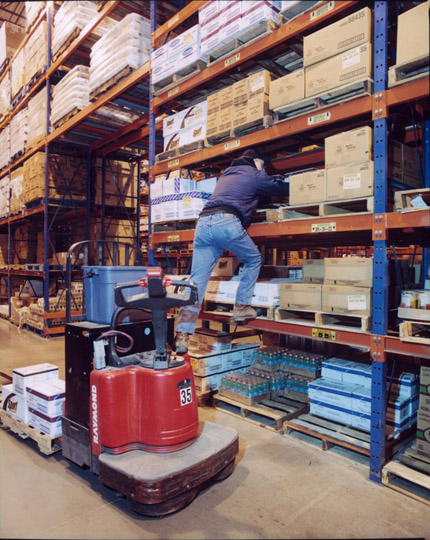
When SKU counts grow and products stay on pallets, pickers often end up climbing into the rack to reach partial pallets on upper levels.
The simplest way to understand whether a product belongs in pallet storage, carton flow, or shelving is to look at how much of it moves over a typical two-week period.
A general guideline that frames the conversation:
Four or five cartons or fewer every two weeks. Products at this volume are usually best served by shelving, where multiple SKUs share the same footprint and pick face density stays high.
More than five or six cases, but less than a half pallet, every two weeks. This is the middle band. These products often end up on pallets by default, but the volume does not justify a full pallet position. They are the strongest candidates for carton flow.
Half a pallet or more every two weeks. Products at this volume earn their pallet positions. Picking directly from the pallet is efficient because the product is moving fast enough to justify the floor space.
As a quick visual cue, here is the above in table form:
| Volume picked every two weeks | Picking system | Use case |
| 4 or 5 cartons or fewer | Shelving | Low movers. Multiple SKUs share the same footprint. |
| More than 5 or 6 cases, less than half a pallet | Carton flow | Middle movers. Strongest candidates for carton flow lanes. |
| Half a pallet or more | Pallet picking | High movers. Volume justifies a full pallet position. |
This is a guideline, not a hard rule. Specific cases vary depending on carton size, throughput patterns, and how the product mix changes over time. But it helps clarify a common mistake: treating every product as a pallet item, regardless of how slowly it actually moves.
What carton flow changes
In a standard carton flow setup, cartons are loaded from the back of the rack into gravity-fed lanes and roll forward as items are picked from the front. For products in the middle volume band, what this changes about the operation is significant.
Pick density compared to pallet picking. A rack bay that previously held two pallet positions can present 10 to 50 individual pick faces once converted to carton flow. For middle-volume products that were being picked directly from pallets, the pick path between SKUs shrinks considerably and more product sits within reach of the same picker. This is typically the single biggest productivity gain when middle movers move out of pallet storage.
Built-in FIFO rotation. Cartons advance in the order they were loaded. For dated product or any operation where rotation matters to a customer, this happens automatically rather than relying on picker behaviour.
Separated pick and replenishment aisles. Replenishment happens from the back of the rack. Picking happens from the front. The two activities stop competing for the same physical space, which removes a common source of congestion and waiting.
Better ergonomics at the pick face. Cartons present at the front edge of the lane rather than being buried at the back of a pallet. Less reaching, less climbing, and a cleaner pick motion that adds up across a full shift.
Configurability for different carton profiles. Carton flow lanes can be set up with wheel track, plastic wheel beds, or steel wheel beds depending on the weight, size, and condition of the cartons moving through them.
Retrofit into existing selective rack. Existing selective racking can often be converted into carton flow pick aisles, which keeps more of the existing structure in play when budget is a factor.
For operations where middle-volume products are still being picked from pallets, these changes are usually felt within days, not weeks.
What shapes the carton flow recommendation
Carton flow is not the right fit for every shelving need, and the strongest recommendations come from looking at a few practical inputs before committing to the system.
The key factors typically include:
Case volume at the pick face. Carton flow earns its value through movement. The recommendation usually starts with how many cases are picked per SKU per day or week.
Carton size, weight, and condition consistency. Carton flow lanes can be configured with wheel track, plastic wheel beds, or steel wheel beds, but the recommendation depends on how consistently the cartons move through the system.
Available depth for replenishment. Because carton flow separates pick and replenishment aisles, the layout needs depth behind the pick face to load from the back.
Pick profile. Carton flow is designed for case picking. For operations that pick individual units or manage small parts, other shelving options including small parts bins, modular drawers, or heavy-duty industrial shelving may be the better fit.
Inventory profile stability. Carton flow lanes are configured for specific carton profiles. Frequent changes in product mix shape how the lanes are sized and how often they need to be adjusted.
These inputs help shape an accurate recommendation rather than committing the operation to a system that does not match how product actually moves.
A short qualification checklist
Before committing to carton flow, the following information makes the planning conversation more productive:
- Case volume per SKU per day or week at the pick face
- Carton dimensions, weight range, and condition consistency
- Available depth behind the pick face for replenishment access
- Clear height and existing rack structure, if a retrofit is being considered
- FIFO requirements driven by product type or customer expectations
- How often slotting changes, and whether lane configurations can absorb that without constant rework
Gathering this information can help avoid the kind of late-stage surprises that delay a project.
Hybrid layouts are usually the strongest answer
Most operations are not all carton flow or all static shelving. The strongest picking environments combine static shelving for slow movers, carton flow for middle-volume case picks, and pallet picking for the fastest movers, sometimes with pick modules or layer picking systems layered in where volume justifies the additional structure.
This is where the system decision becomes a design decision. Carton flow, static shelving, pallet picking, and pick modules are not competing options. They are tools that fit different parts of the same operation, and the question is how they work together.
The shelving decision is rarely just about shelving
If walk time, mispicks, or replenishment congestion are showing up in daily operations, the constraint may not be labour or shelf space. It may be the way product is presented to the picker.
Carton flow is one option for operations that have grown past what their current storage approach was set up to do. Whether it is the right answer depends on the inventory profile, the layout, and how the picking operation is expected to scale.
For a broader look at how shelving systems fit together in modern warehouse environments, the Complete Guide to Warehouse Shelving Options covers industrial shelving, carton flow, pick modules, and refurbished systems in more detail.
If walk time or pick accuracy is becoming a concern in your facility, we are happy to talk through what your current layout is doing well and where carton flow or a hybrid approach might help. Get in touch to start the conversation.