When an Ontario inspector arrives and asks for proof that your pallet racking is safe, you need to be able to produce the right documentation, show that loads are clearly posted, and demonstrate that your facility is managing racking conditions through routine checks.
This guide explains the three distinct compliance needs that come up in Ontario warehouses, what inspectors typically look for, and what to do if your documentation is incomplete or missing.
Note: This article is general information, not legal advice. Requirements can vary by municipality and situation.
Three separate problems that often get confused
“Racking inspection” gets used as a catch-all term, but in practice there are three distinct compliance needs, and mixing them up is one of the most common sources of frustration for facility managers.
- Structural capacity documentation: Can you prove how much weight the rack safely holds?
This is the engineering and certification pathway: stamped drawings for new, properly installed racking, or a Pre-Start Health and Safety Review (PSR) for used, reconfigured, or previously uncertified rack. It’s what the Ministry of Labour is primarily looking for.
- Damage inspection: What is the current condition of the rack, and what needs to be repaired?
This is a separate, condition-focused review that produces a prioritized list of issues, supported by photos and repair recommendations. Many facilities assume a PSR covers this. It doesn’t.
- Permitting: Does your municipality require a racking permit, and have you obtained one?
This is a building code matter handled through your municipality, not the Ministry of Labour. It’s becoming significantly more common as building codes evolve.
“A PSR is to certify the rack structure and see what it could load before you load pallets onto it,” says Chase Anderson, Technical Sales Representative at 3D Storage Solutions. “A racking permit, on the other hand, is basically a building permit… you’re requesting to build something and anchor it to the floor.”
What Ministry of Labour inspectors typically want to see
MOL inspectors don’t follow a single universal script, but most compliance gaps come down to a short list of missing items:
Load capacity documentation. Either stamped drawings (for new, engineered rack installed to spec) or a PSR report (for used, moved, reconfigured, or previously uncertified rack). When an inspector finds this missing, facilities are typically given a deadline (often around 30 days) to produce it. Think of it like being pulled over and not having your licence on you: you have a limited window to show it exists.
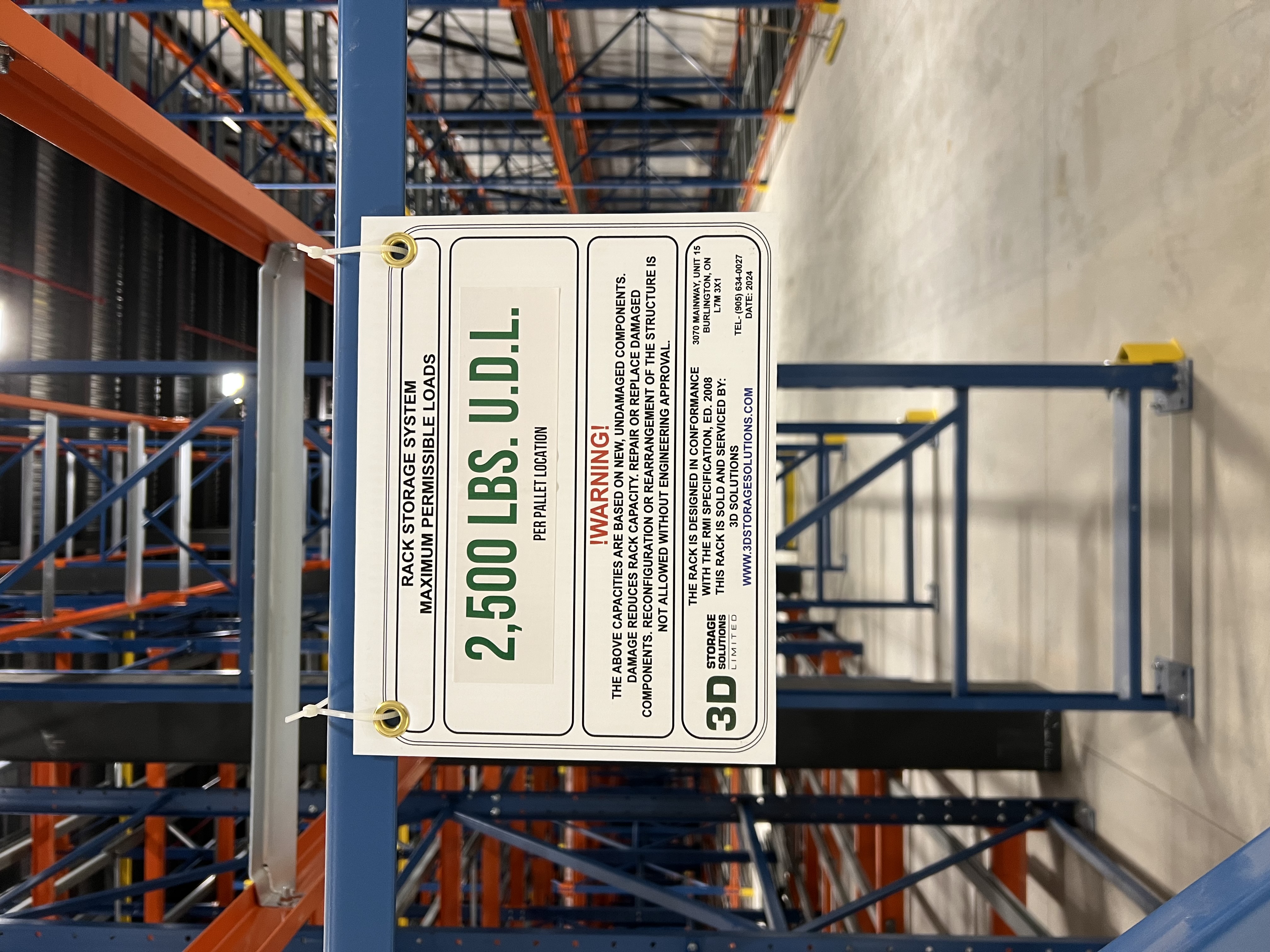
Clear load rating signage. Signs posted at rack ends showing allowable loads per level. This allows operators to know load limits in real time, and gives inspectors visible evidence that loads are communicated to the people working in the space.
Evidence of an ongoing inspection routine. Most well-run facilities use a combination of monthly internal checks and an annual external inspection. Documented findings, even when there’s nothing to report, matter here.
Stamped drawings vs. PSR: which do you need?
Stamped drawings are the engineering documentation produced when racking is designed and manufactured to a defined specification. If your rack was installed new, per the manufacturer’s engineered design, stamped drawings establish that it was built and loaded correctly from the start.
A PSR (Pre-Start Health and Safety Review) is a legislative requirement under O. Reg. 851, Section 7. An engineer reviews the rack as it exists: assessing steel gauge, beam elevations, placement, and structural integrity and certifies what it can safely hold.
PSRs come up most often when:
- Racking is used or of unknown origin
- Rack has been moved, reconfigured, or reinstalled
- Original engineering documentation is missing
- The rack has been modified in a way that could affect capacity
- Building codes have changed since the original installation
One critical point: a PSR is not a damage inspection. The engineer’s mandate is to assess structural integrity and certify load capacity, not to produce a repair list.
“The engineer will tell you what you’re missing to get certified, but they won’t tell you what to repair,” says Anderson. “They’re there to look at the integrity of the rack and tell you how much weight it can store.”
Damage inspections
A damage inspection answers a different set of questions: Which uprights, beams, braces, or anchors are compromised? What’s urgent versus monitor-only? What needs to be repaired, and in what order?
The output is typically a stamped engineer’s report with photos, severity ratings (often tiered from high to low urgency), and a repair scope that can be quoted directly. This is distinct from both the PSR process and a routine internal walk-through.
A damage inspection is the right tool when:
- Racking has experienced repeated forklift impacts
- You’re taking over an existing facility with rack you didn’t install
- You want a defensible, documented picture of rack condition before an inspection or lease renewal
- You suspect damage but need a formal assessment to support repair decisions
At 3D, a certified damage inspection runs approximately $2,000 and produces a stamped report. From there, repair costs are quoted based on severity findings. Anderson notes it’s not uncommon for repair scopes on older, well-used rack to reach $30,000 or more.
Racking permits: what’s changing and why it matters
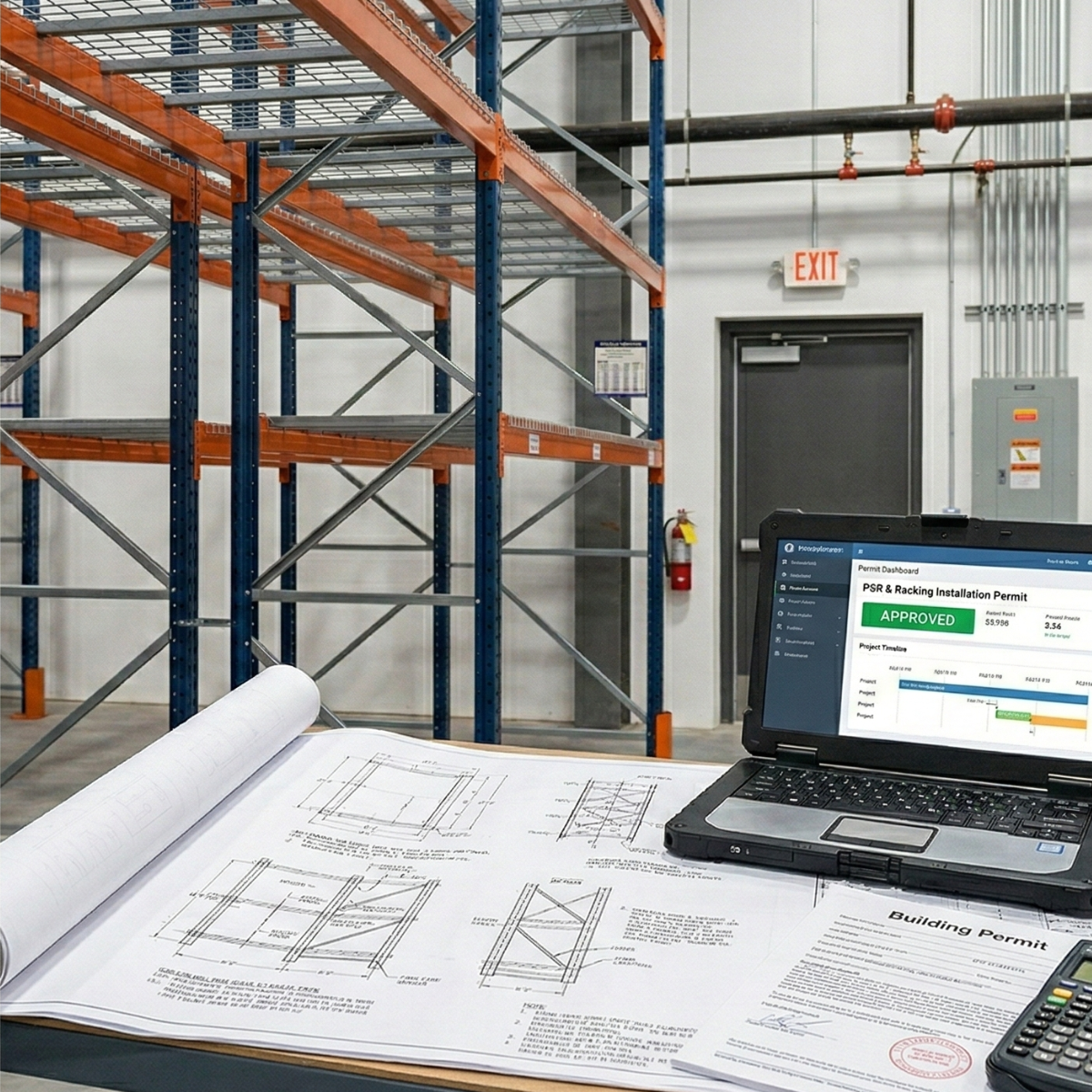
Racking permits (essentially building permits that cover the installation of storage rack) are becoming a standard requirement across Ontario municipalities.
“It’s becoming more of a request nowadays,” says Anderson. “Landlords are asking for permits more and more often. And with the 2024 building code changes, racking is now classified as a building structure rather than industrial furniture which is exactly why permits are required.”
What a permit process typically involves:
A racking permit isn’t a single form. Pulling one together requires coordinating several engineering and life-safety reviews simultaneously. At 3D, that coordination is handled by Nancy Lam, who manages the permitting process end-to-end.
“The municipalities are all a little different,” says Lam, “but there’s a core set of documentation that comes up every time: sealed rack drawings, structural slab review, life safety and egress plan, sprinkler review, and electrical review for emergency lighting.”
In practice, this means:
- Sealed rack drawings certifying that the structure can support intended loads and is properly anchored
- Slab letter confirming the floor can bear the racking load
- Egress/life safety plan showing clear travel paths from rack aisles to exits; now subject to a 45-metre maximum distance rule in larger distribution centres, which can meaningfully reduce pallet positions
- Sprinkler review by a fire suppression engineer confirming adequacy (or specifying upgrades required)
- Electrical review for emergency lighting within rack aisles; now a code requirement
Some municipalities also require a letter of intended use, an OBC matrix from the building’s architect, or other site-specific documentation. Review periods are typically 20 days, though Lam notes municipal backlogs can push that timeline significantly longer.
The real cost of skipping a permit:
The permit process has a fee. 3D’s service runs $6,000–$7,500, with additional municipal application fees that vary (sometimes tied to a percentage of construction value). For smaller rack installations, the economics may not support it.
But the cost of being caught without one is steeper. A building inspector who finds unpermitted racking can issue a stop-work order, levy fines, and require the permit to be obtained after the fact— typically at double or triple the standard fee, and potentially while your operation is shut down.
“You either pay it now or pay it later,” Anderson says.
There’s also the operational timing problem. A customer in Whitby learned this the hard way: with a $2 million rack project ready to go, the landlord refused to allow construction to begin before the permit was in hand. The team had to approach the city for a special exemption before a single upright could be installed. “We couldn’t do anything about that,” Anderson says. “There are lead times, and a lot of that is out of our hands once it’s in the city’s queue.”
When permits are most likely to apply:
- New facility builds or tenant fit-ups
- Relocating to a new warehouse
- Major rack reconfigurations or additions
- Any project where the landlord has specified a permit as a lease condition
For smaller installations, a few bays in a maintenance room, for example, a PSR and load signage may be sufficient and proportionate. The right path depends on scope, municipality, and lease terms.
What a practical inspection-ready routine looks like
Most facilities that are consistently prepared for an MOL visit operate on a two-track model:
Monthly internal inspections conducted by health and safety committee members or designated staff. The goal is early identification of damage, not certification. Documented findings (including “nothing to report” entries) build the paper trail that demonstrates active management.
Annual external inspection by a qualified outside party, producing a formal report with prioritized action items. This is the defensible record that carries weight with an inspector asking for evidence of an ongoing program.
Repairs should be documented with dates, photos, and completion notes. Trigger events such as a significant forklift impact, a rack move, a change in load profile, or new handling equipment should prompt an out-of-cycle review rather than waiting for the next scheduled inspection.
Readiness checklist for Ontario warehouse operators
Use this as a quick scan before an inspection occurs.
Documentation
- Do you have stamped drawings or a PSR report on file, as appropriate to your situation?
- If an exemption applies, can you produce supporting documentation immediately?
- Are load ratings posted at rack ends and legible?
Condition
- Are aisles clear, and are impact-prone areas protected?
- Is there documented evidence of damage follow-through; not just findings, but repairs and dates?
Inspection routine
- Do you have monthly internal inspection logs, including negative findings?
- Do you have an annual external inspection report from the past 12 months?
Trigger events: when to re-check
- Any rack moves, reconfigurations, or component changes
- Repeated forklift impacts
- Changes in load profile (heavier pallets, new SKU mix, new equipment)
- Any change in tenancy, lease, or facility use
How 3D Storage Solutions can help
3D’s compliance support spans all three areas: engineering documentation and permitting, racking condition reviews and damage inspections, and repair or replacement planning based on findings.
If you have an upcoming inspection, are relocating to a new facility, are missing documentation, or have concerns about damage, contact us to request a racking compliance review before you’re working against a deadline.