Pushback pallet racking is often chosen when a facility needs higher density without losing flexibility. It is designed to increase pallet positions while keeping more pick faces available than lane-based systems like drive-in racking.
In most layouts, pushback stores product 2 to 6 pallets deep, which is why it is frequently shortlisted when space pressure rises but selective racking still feels operationally necessary.
A common best-fit profile is SKUs with roughly 5 to 50 pallets per product, where the operation benefits from density gains without committing to deep, dedicated lanes.
How pushback racking works (inclined rails and nested carts)
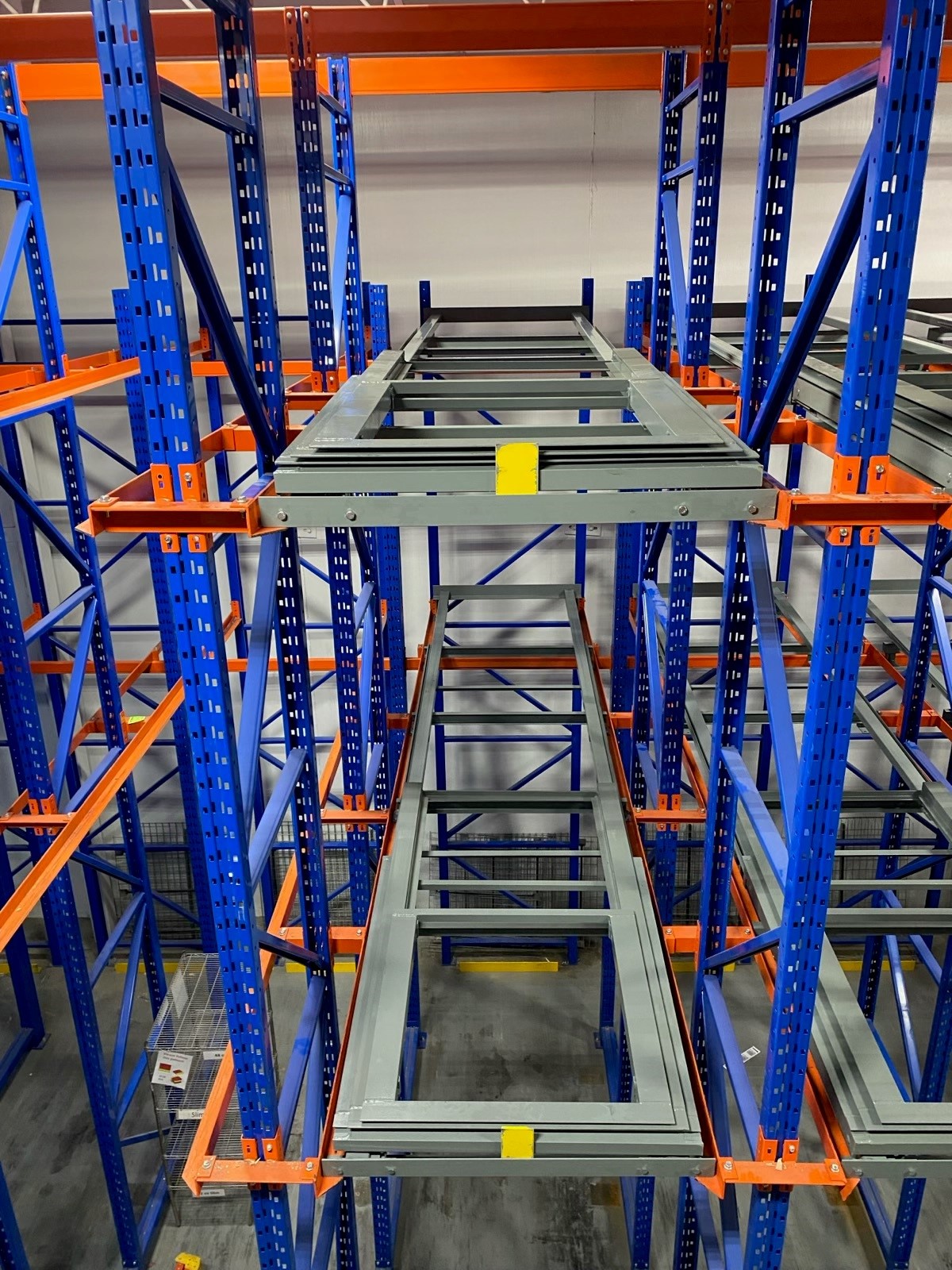
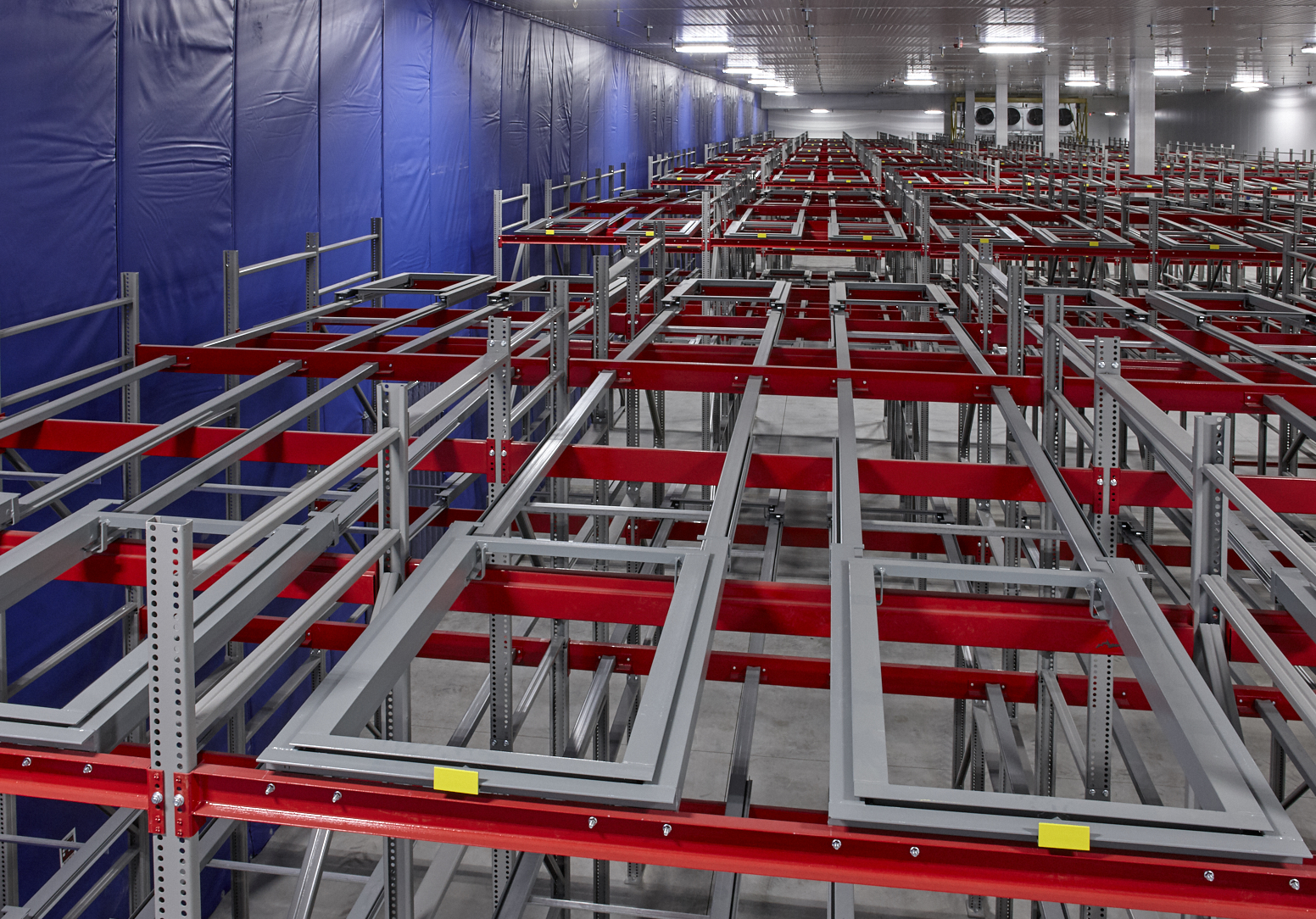 Each pushback lane is built with a pair of inclined rails and a series of nested carts. In a five-deep system, for example, there are four carts.
Loading follows a simple pattern. The first pallet sits on the top cart. Each new pallet pushes the previous pallet back, exposing the next cart. The last pallet is placed on the rails themselves.
When retrieving product, the lift truck removes the front pallet and the pallets behind it roll forward gently to the face. The practical advantage is that the work stays at the aisle, with no need to drive into the racking.
When pushback pallet racking is the right choice
Pushback is usually a strong fit when these conditions apply.
Space pressure is rising, but selectivity still matters
Facilities often hit a point where selective racking is no longer enough, but the operation still needs flexibility. Pushback increases density while preserving more pick faces than drive-in style lanes.
SKU profile is “medium depth”
If there are too many pallets per SKU for selective racking to stay space-efficient, but not enough volume per SKU to justify very deep lanes, pushback often sits in the sweet spot. The pattern is mid-volume SKUs stored several pallets deep.
The operation needs higher density without the drive-in handling pattern
Drive-in racking can deliver strong density, but it changes daily handling behaviour. Pushback keeps most handling at the aisle face, which can make it easier to operate, train, and adapt as the product mix shifts.
Flexibility is a priority, not just maximum density
Pushback depth can be configured from 2 to 6 deep, which supports a wider range of layouts and tends to be more forgiving with smaller lot sizes than drive-in.
Pushback vs drive-in racking: what actually changes
Pushback and drive-in are both high-density systems, but they create different day-to-day realities in the warehouse.
Drive-in racking
- Maximizes density by storing many pallets deep in a lane
- Generally lower selectivity because lanes are dedicated and deep
- Requires lift truck travel into the rack structure for loading and retrieval
Drive-in is frequently a fit when a facility stores large volumes of the same product and can live with lower selectivity.
Pushback pallet racking
- Increases density while retaining more pick faces than drive-in
- Brings pallets back to the aisle during retrieval, so access is faster and operators do not need to drive into the racking
- Handles changing inventories well, especially when each level may be loaded with different product
In short, pushback is often chosen when the operation wants meaningful density gains but cannot accept the selectivity trade-off and handling pattern that come with drive-in.
Benefits buyers often underestimate
Higher occupancy in real operations
A practical advantage of pushback is higher overall occupancy because each level of the system can be loaded with different product, rather than forcing long, dedicated lanes.
Quick access from the aisle
When pallets are removed, remaining pallets roll forward to the pick face. There is no drive-in travel, which often translates to faster access and simpler handling.
Improved safety features
Pushback systems can include features like linked carts, low profile design, cart lift-out protection, and lane full indicators.
Product versatility
Pushback lanes can be designed to handle loads up to 5,000 pounds, accommodate a variety of pallet sizes and types, and operate in cold environments down to minus 60 degrees Celsius.
Cost-effective density
When configured with floor storage underneath multiple levels of racking, pushback can be very cost effective, often comparable to drive-in from a density-per-dollar perspective.
A better question than “Do we need FIFO?”
A better question is: What problem is FIFO meant to prevent in this specific operation?
Often the real requirement is one of these:
- Preventing spoilage or expiry issues
- Ensuring date or lot rotation
- Avoiding forgotten inventory at the back
- Maintaining consistent quality control processes
When pushback can still work in FIFO-sensitive operations
Pushback can still be viable when FIFO discipline is achieved through operational controls, such as:
- Loading and picking full lanes as a unit (common when shipping full pallets in full-lane quantities)
- Storing single-lot or single-date product per lane (rotation happens lane-by-lane rather than pallet-by-pallet)
- Using location control in the Warehouse Management Solution so older pallets are directed to be picked from lanes that hold older inventory first
This is not the same as saying pushback becomes true FIFO. It does not. But it does mean a warehouse can meet real-world rotation goals with pushback in specific use cases, instead of ruling it out at the shortlist stage.
If the operation requires strict FIFO pallet-by-pallet, especially at high speed, pallet flow is usually the more direct answer.
Where pushback racking is commonly used
Freezers and coolers
Every cubic foot of a freezer is expensive. Pushback is often used to maximise density and improve ROI in cold storage environments.
Food and beverage
Food and beverage operations often evaluate pushback because it can deliver strong density and, when properly configured, can support FIFO outcomes depending on inventory mix.
Third party logistics (3PL)
Many 3PLs use selective racking as the backbone, then add 2- or 3-deep pushback rows to increase capacity while staying flexible enough for changing inventories.
Common questions about pushback pallet racking
 Is pushback pallet racking safe?
Like any racking system, safety depends on correct design, installation, and ongoing inspection and maintenance. Pushback can also incorporate safety features like linked carts, cart lift-out protection, and lane full indicators.
How deep can pushback racking be?
Pushback systems are commonly configured 2 to 6 pallets deep, with the right depth driven by SKU profile, pallet weights, lift truck behaviour, and throughput.
Is pushback always better than drive-in?
Not always. Drive-in can be the better fit when the highest priority is maximum density for large volumes of the same SKU and the operation can accept lower selectivity and lane-based handling.
Does pushback work for cold storage?
Yes, it can. Pushback can be designed for cold environments down to minus 60 degrees Celsius, but the right answer depends on the product and the operating model.
A simple decision framework
Pushback pallet racking is often the right choice when the facility needs:
- Higher density than selective racking
- More flexibility and pick faces than drive-in racking
- A strong fit for medium-depth SKUs, often in the 5 to 50 pallets per SKU range
- A solution that can support practical rotation goals without demanding strict pallet-by-pallet FIFO
If the facility needs strict FIFO at high speed, pallet flow should be evaluated. If the facility needs maximum density for large volumes of the same SKU and can accept lower selectivity, drive-in may be a better fit.